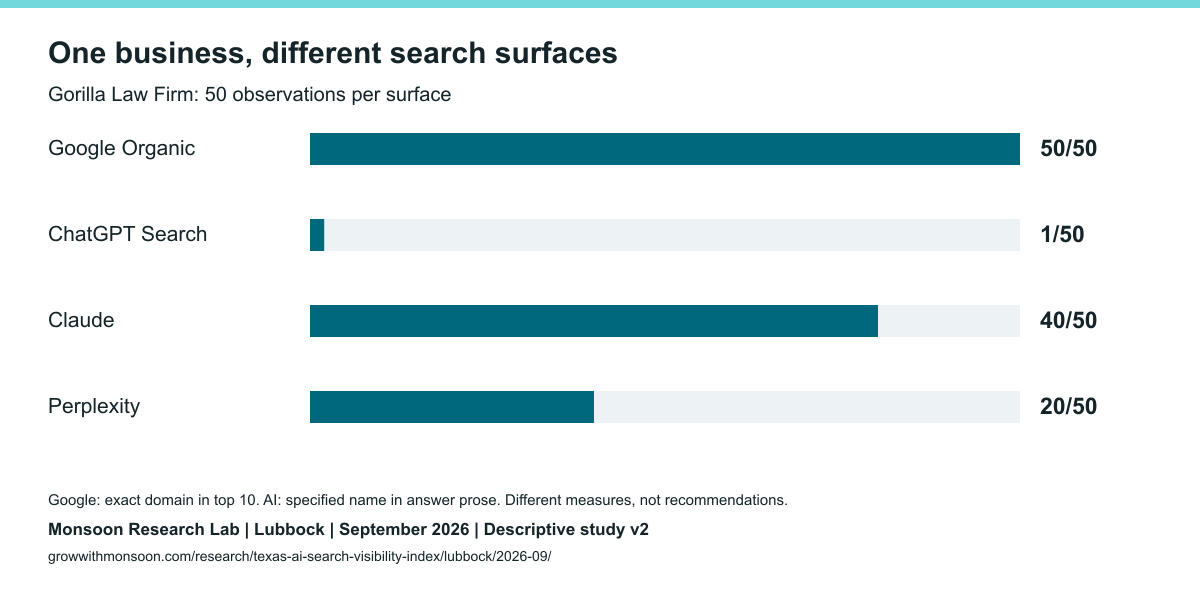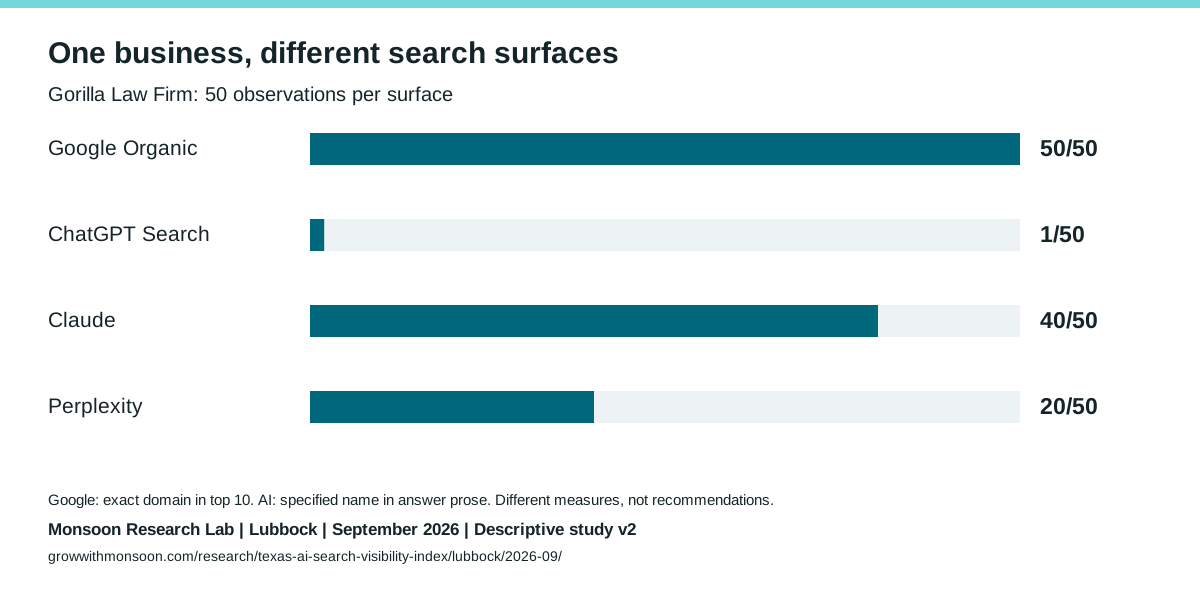
Across 20 Lubbock industries
Showing up on Google does not guarantee regular appearances in AI answers.
139 of 244 tracked business website groups, about 57%, appeared in Google's top ten at least once but were named in fewer than one in ten sampled answers on at least one AI platform.
The qualifying groups span all 20 industries studied. This is a finding across the full tracked cohort, not a single-business example.
This measures low name detection, not complete absence from AI. Website groups can include multiple locations or national brands. It is not a percentage of every business in Lubbock.
How we calculated the Google-to-AI gap
We included every tracked business website with at least one top-ten Google appearance in the pilot. A shared domain counts once. For each, we checked the five paired questions and ten repetitions on ChatGPT Search, Gemini, Claude and Perplexity in the industries where that website appeared on Google.
The threshold is fewer than 5 of 50 answers per platform. Eight website groups appear in two Google-visible industries, so their 100 answers are pooled and the equivalent threshold is fewer than 10 of 100. A single Google appearance qualifies a website for this comparison; it does not mean that website consistently ranks highly.
We reviewed shortened names, legal suffixes, punctuation, acronyms and scraped name formatting. Corrections reduced the initial 168 qualifying groups to 141. Two unresolved groups are withheld from the headline count, while remaining in the denominator. Known uncertain name matches are treated as possible detections before a group qualifies.
| AI surface | Qualifying groups / 244 |
|---|---|
| ChatGPT Search | 45 / 244 |
| Gemini | 84 / 244 |
| Claude | 72 / 244 |
| Perplexity | 32 / 244 |
The platform counts overlap. A website group qualifying on multiple platforms counts only once in the 139. This does not measure recommendations, citations, customer traffic, business quality or algorithmic causes. An own-website link without a name is not counted as a name detection.
Download the calculation, cohort and observation IDs (JSON)
Exploratory follow-up completed September 11, 2026, using unchanged study v2 evidence. The below-10% threshold was chosen after collection. Repeated answers are not independent consumer samples. Automated checks and builder review are not independent human review; unknown aliases may still affect counts.
Original tables are unchanged; the original article and brief remain archived. The earlier conservative zero-detection calculation uses a different definition. It should not be compared as a change over time.